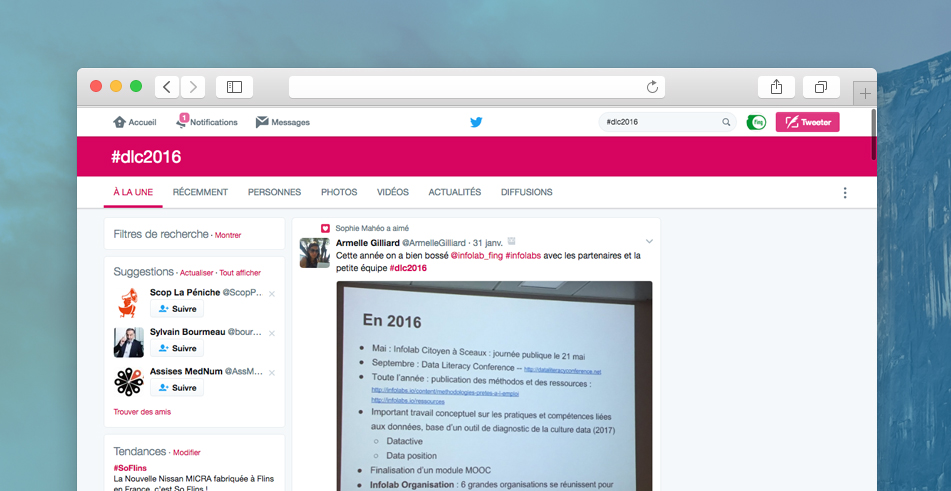
September 23-24 2016 Aix-en-Provence, Conservatoire Darius Milhaud. #DLC2016
In companies and administrations, at schools, in R&D departments as well as in society at large, cultivating data awareness is now as important as teaching people to read, write and do arithemetic. Data illiteracy is creating considerable inequality asymmetry among individuals and organisations, and across the whole of society. Nurturing and enabling data awareness, on the other hand, can lead to real empowerment – and to the development of novel practices that solve both little and big problems.Nevertheless, cultivating data proficency, management and ownership is no simple task. As of today, ourtechnical know-how is not up to scratch. Yet how many schools are teaching the tools and techniques of data exploration?
This event will explore data as a resource for knowledge, and a domain of expertise, languistic, grammatical, typos, literary, educational, pedagogical, methodological, and artistic point of view. . We bring together the earliest thinkers and doers from the world of data literacy, so that together, we can uncover some early answers to key questions related to data literacy: why should people become data literate? Data literacy for whom? Who are the key players in the data game? What does data awareness really mean? How can we develop a data mindset as individuals, as organisations, and as a society? Have fundamental data skills been exhaustively identified? Is it possible to create desire out there, in the cold (data-)world? Is organisational data awareness an innate or an acquired trait?
The following organisations projects leaders and key players will be invited:
Aviz, Catherine D’Ignazio, la Coop Infolab, Data Carpentry, Data Cuisine, Data for decisions, Data mindset playbook from MoData, Data pop Alliance, Data & Society, Datajournalism handbook, Dataphys.org, Datatherapy, Dear Data, Etalab, Fréquence Écoles, infolabs.io, Jose Duarte (Handmadevisuals), J++, LINC, Medialab de Science Po, Open Knowledge, School of Data, le Tubà, Tuvalabs, Using data, etc.
Qu'est-ce qu'une véritable culture ou "littératie" des données ? Pourquoi ne pas laisser faire les spécialistes ? Qu'est-ce qu'un "état d'esprit" données ? Est-ce qu'il transforme mes projets, mon travail, mon équipe, mon entreprise, ma communauté, mon territoire ? Et comment s'y prend-on ? Comment traduire pour des non-spécialistes des savoirs et pratiques avant tout techniques ? Parle-t-on d'astuces, de bonnes pratiques, de méthodologies ou d'un véritable savoir en train de se constituer ? Six intervenants racontent leurs expériences pratiques pour développer une véritable culture des données dans leurs projets, leur organisation, leur communauté, leur territoire.
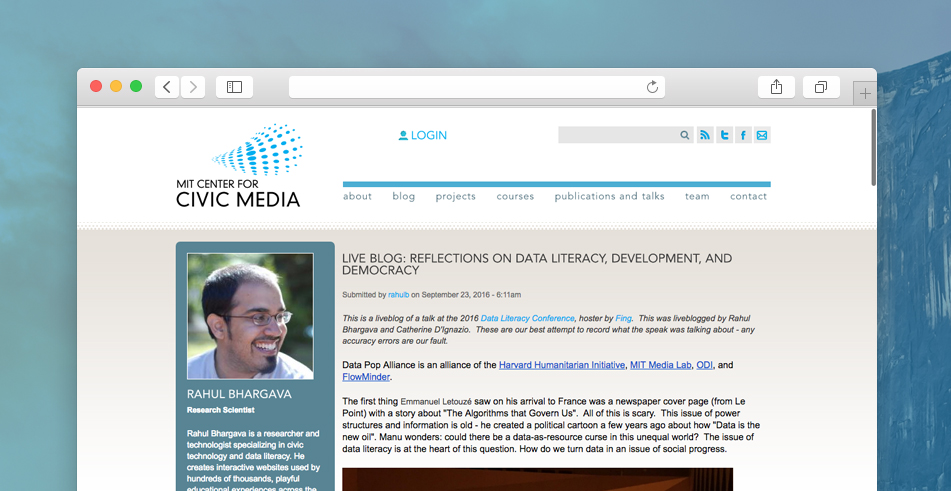
Rahul Bhargava liveblogging:
Reception at the Conservatoire.
Four speakers tells their experiences and how they experiment a true data culture in their projects, organisations, communities, territories.
A key observer give his point the view on the journey, the talks, the productions.
On behalf of Data Literacy Conference, datactivi.st's founders invite you to celebrate the creation of the company (on registration).
A whole room is dedicated to demos & very short workshops (less than 20 minutes).
The room is open to every demonstration/exhibition: just bring up yours!
by the community
4 parallel workshops: propositions are brought up by the participants and chosen by the community at the beginning of the session.
Come and share your propositions on the spot, that very day..
by the community
Second session of the barcamp.
Research scientist at MIT Center for Civic Media
Rahul Bhargava is a researcher and technologist specializing in civic technology and data literacy. As a Research Scientist at the MIT Center for Civic Media, Rahul leads technical development on projects ranging from interfaces for quantitative news analysis, to platforms for crowd-sourced sensing. He has a special interest in how new technologies are introduced to people in settings focused on learning.

Co-founder Fréquence École
Dorie Bruyas, co-founder of Fréquence Écoles, leads the digital media projects for education. She focuses on strategic skills for the youth too empower their actions in the digital world. Conferencer, teaching plans builder, she's passionate about new technologies, robotics, coding, Data, and innovation in education.

Data Editor at Etalab
Simon Chignard is Data Editor at Etalab, national french department for Open Public Data (data.gouv.fr). He previously helped private and public actors in their data strategy and wrote two books in these fields: "Open Data" (2012) and "Datanomics" (with Louis-David Benyayer, 2015)

Assistant Professor of Data Visualization and Civic Media at Emerson College
Catherine D’Ignazio is an Assistant Professor of Civic Media and Data Visualization at Emerson College. She is a researcher, artist and software developer. Her work focuses on data literacy, postpartum tech innovation, participatory design and civic art. It takes the form of public art, design, code, classes, workshops and writing. She has recently co-developed a suite of tools for data literacy (DataBasic.io)

Projects coordinator @SchoolOfData
School of Data works to empower civil society organizations, journalists and citizens with the skills they need to use data effectively. Meg's role involves helping to run key School of Data activities such as the annual Summer Camp and the Fellowship. Prior to School of Data, Meg worked as a legal adviser to detained asylum seekers and has a particular interest in data literacy in the field of human rights.
Director at La Reine Merlin
Armelle Gilliard is an Open Data expert and an innovative project manager. She writes guidebooks about public data: about public data reuse to reusers (Guide lines to ask local authorities public data) and, more recently, two guides to local authorities (Glossary of public data, Public data in the law). She works on data mediation process and she is involved right from the beginning in FING’s Infolabs programme.

PhD students in design et psychology at Paris 8 (Labex Arts-H2H, Laboratoire Paragraphe - C3U) and EnsadLab.
Her research focuses on the design of trace-collection technics to capture human activities for educational settings, both formal (schools) and informal (fablabs). These tools seek to engage learners in reflective processes, mainly through non‐verbal channels.

Associate professor in Design and ICT at Telecom Paris Tech in France
For his work on “constructive visualization” he received the 2015 best doctoral dissertation award from IEEE VGTC Pioneer Group. His research is mostly focus on the design process of visual representation of data, design methods apply to research and computer human interaction. His approach is grounded in fifteen years of experience in industry with interactive media industries where he worked for a broad range of civic, cultural and corporate clients.

Researcher in communication science Université Paris 13
Sarah's researches focus on two main domains: Digital media and the developpment of new cultures ; and policies related to Open Data and Open Government. With a key question in mind, how organisations transforms their strategies and policies through media and data usages.
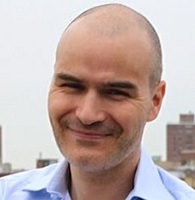
Co-Founder & Director @datapopalliance
Emmanuel is Co-founded and directing Data-Pop Alliance, a global coalition on Big Data and development co-created by the Harvard Humanitarian Initiative (HHI), the MIT Media Lab, and the Overseas Development Institute (ODI) to promote a people-centered Big Data revolution. Our goal is to leverage and shape the future of Big Data to foster human development and social progress through the ethical use of personal digital data and empowerment of the poor and most vulnerable in ways that avoid the pitfalls of a new digital divide, de-humanization and de-democratization.

Co-Founder & CEO at Tuva
Harshil Parikh is the Co-Founder & CEO of Tuva, a company with a simple claim: "Become Data Literate Today". Before launching Tuva (tuvalabs.com), Harshil was based in Mumbai and led Global Business Development for Greenlight Planet. Harshil received his BS in Engineering Physics from University of Illinois at Urbana-Champaign and a MS in Financial Mathematics from North Carolina State University.

Director at fabriders
Dirk Slater has spent the last two decades helping activists and advocates in over 30 countries use information and technology as tactics in their campaign strategies. Dirk Slater lead up a research to understand data literacy efforts around the world, based on the School of Data cases.
Organisers






Co-funders



Medias & Communication